
Brown County Release Starts Elsewhere
Brown County released inmates do not come from a Brown County jail. The Illinois Sheriffs' Association county profile states both “No jail” and “No Jail” for the administrator and address. The Brown County Sheriff's Office arrests, processes, and transports people, but the actual receiving facility varies by case. That receiving jail owns its booking and physical release transaction. The Sheriff may hold the arrest report, transport destination, and a local custody outcome. The Circuit Clerk holds the court orders that explain why detention ended. These are separate records, and one office may not have the whole chain.
“Released” must name the custody that ended. A person can leave an arresting officer and enter another jail, IDOC, federal custody, or immigration custody. That is a transfer, not release to the community. A true community release may follow a pretrial order, time served, dismissal, probation sentence, or completion of a term. Release from an IDOC prison to mandatory supervised release, often called MSR, ends prison confinement but not IDOC legal custody. Final discharge comes later. The right Brown County release search depends on which of these events occurred.
Brown County has no current jail roster. Disappearance from another facility's roster can mean release, transfer, a new authority, or a display change.
Brown County Release Outcomes
Each outcome points to a different record keeper. Illinois now uses a pretrial-release framework, so an older phrase such as “bonded out” may not describe the legal order in a new case. Read the docket and order. A receiving jail's transaction supplies the time when custody physically ended, while the court record supplies the authority. Holds and separate cases can prevent release even after one charge is dismissed or one order permits release.
| Outcome | What it means | Best next record |
|---|---|---|
| Pretrial release | The case continues outside detention under a court order and possible conditions. | Brown County docket, order, and the receiving jail's release entry |
| Time served | The custodial term is satisfied, subject to the actual credit calculation and other holds. | Sentence or mittimus plus the custodian's release transaction |
| Probation or conditional discharge | A community sentence replaces or follows confinement. | Court disposition and probation office confirmation |
| IDOC parole or MSR | Prison confinement ends while state supervision and legal custody continue. | IDOC profile, Parole Date, location, and status |
| Transfer | Custody continues at another jail, IDOC, USMS, or ICE. | Origin record naming the destination, then the destination's record |
| Final discharge | The relevant correctional sentence and state custody have ended. | IDOC archived record when the public profile has disappeared |
- Mittimus
- The court document that commits a sentenced person to custody and records the sentence.
- MSR
- Mandatory supervised release, a period of community supervision after an Illinois prison term.
- Detainer
- A request from another authority to hold or transfer a person rather than release them.
- Discharge
- The end of the sentence or legal custody, distinct from release from a prison building.
Brown County Release Record Fields
There is no single Brown County jail database. Ask for the smallest set of records that reconstructs the event. The Sheriff's arrest and transport material should identify the receiving agency. The receiving jail's booking and release transaction should show when custody began and ended. The court docket or certified order should explain the authority. For IDOC custody, the public or archived offender record uses its own sentence and parole fields. Request the code definition whenever a response gives an unexplained release abbreviation.
| Field | What it shows |
|---|---|
| Name and identifier | Connects the arrest, booking, court case, or IDOC number to the same person. |
| Admission date and time | When the particular custodian accepted the person. |
| Release or transfer date and time | When that custodian's physical control ended. A date alone does not prove the hour. |
| Reason or code | Pretrial order, time served, court action, parole, discharge, or another coded outcome. |
| Destination agency | Shows whether the event was a transfer rather than community release. |
| Case or order | Links the physical transaction to the legal authority. |
| Supervision status | Identifies probation, parole, MSR, or a final discharge when applicable. |
A historic Illinois sheriff's jail register could contain personal descriptors, committing authority, offense, and the date and reason for release. That archival pattern is useful context, but it does not prove that Brown County operates a current register. The modern request should target records actually held by the Sheriff, the receiving jail, the Circuit Clerk, or IDOC. An old arrest entry does not prove current custody or a recent release.
Request Brown County Release Records
Start narrow. Brown County did not publish a local Sheriff FOIA form, fee schedule, or jail records desk in the reviewed sources. Illinois FOIA generally calls for a response to a noncommercial request within five business days, subject to lawful extension, denial, and exemption rules. That period is a response deadline, not a promise that every requested item will be produced. The first 50 pages of standard black-and-white letter or legal copies are generally free, after which statutory actual-cost limits apply. Electronic delivery avoids assumptions about paper charges.
- Gather the full name, event date, Brown County case or incident number, and any known booking identifier.
- Ask the Sheriff which agency or facility accepted custody. Request the arrest, transport destination, transfer outcome, and any image actually held.
- Send the identified jail a focused request for admission and release times, reason or code definition, authorizing case, and destination if transferred.
- Ask the Circuit Clerk for the docket, detention or release order, sentence, mittimus, or certified disposition. Court access and certification rules apply.
- If the chain reaches IDOC, request public archived admission, actual parole or release, final discharge, status, and sentence fields through IDOC FOIA.
200 Court Street, Room 1
Mt. Sterling, IL 62353
217-773-2011
sheriff@browncoil.org
The official county directory separately lists 217-773-2061. The emergency-services and Sheriffs' Association sources support 217-773-2011, so that number leads here while the conflict remains visible. For IDOC archives, send a focused request to IDOC's Freedom of Information office at DOC.FOIARequest@illinois.gov or call 217-558-2200 extension 4166. Keep the acknowledgment, response date, exemption citation, and any referral to a different custodian.
Brown County Release Record Limits
5 ILCS 140/3 supplies the general Illinois FOIA response framework, and 5 ILCS 140/6 governs fees. Arrest-report disclosure has more specific treatment in 5 ILCS 140/2.15. Records are not kept forever merely because they are public. The Local Records Act controls authorized disposal, while court materials follow court-access and retention rules.
Sealing, expungement, juvenile confidentiality, impoundment, safety concerns, and investigative exemptions can lawfully narrow or remove access. Illinois expungement and sealing rules appear in 20 ILCS 2630/5.2. A missing result may therefore be correct. It is not sound to rebuild restricted information from mirrors. Narrow a denied request to segregable release fields, or use the official court process when certification is needed.
Brown County Pretrial Release Support
Brown County has a local Office of Statewide Pretrial Services contact. Brandi Goben can be reached at 217-481-5637 or bgoben@ilosps.gov. Pretrial supervision means a criminal case is still pending while the person remains in the community under court-set conditions. It is not time served, probation, IDOC parole, or final discharge. The filed Brown County order controls the legal conditions, while the actual receiving jail records when physical detention ended.
The Brown County OSPS office page also gives an important fraud warning: its supervision and GPS services are free. A demand for payment supposedly tied to OSPS release or monitoring should not be treated as an official charge. The official page's layout and contact are shown below.
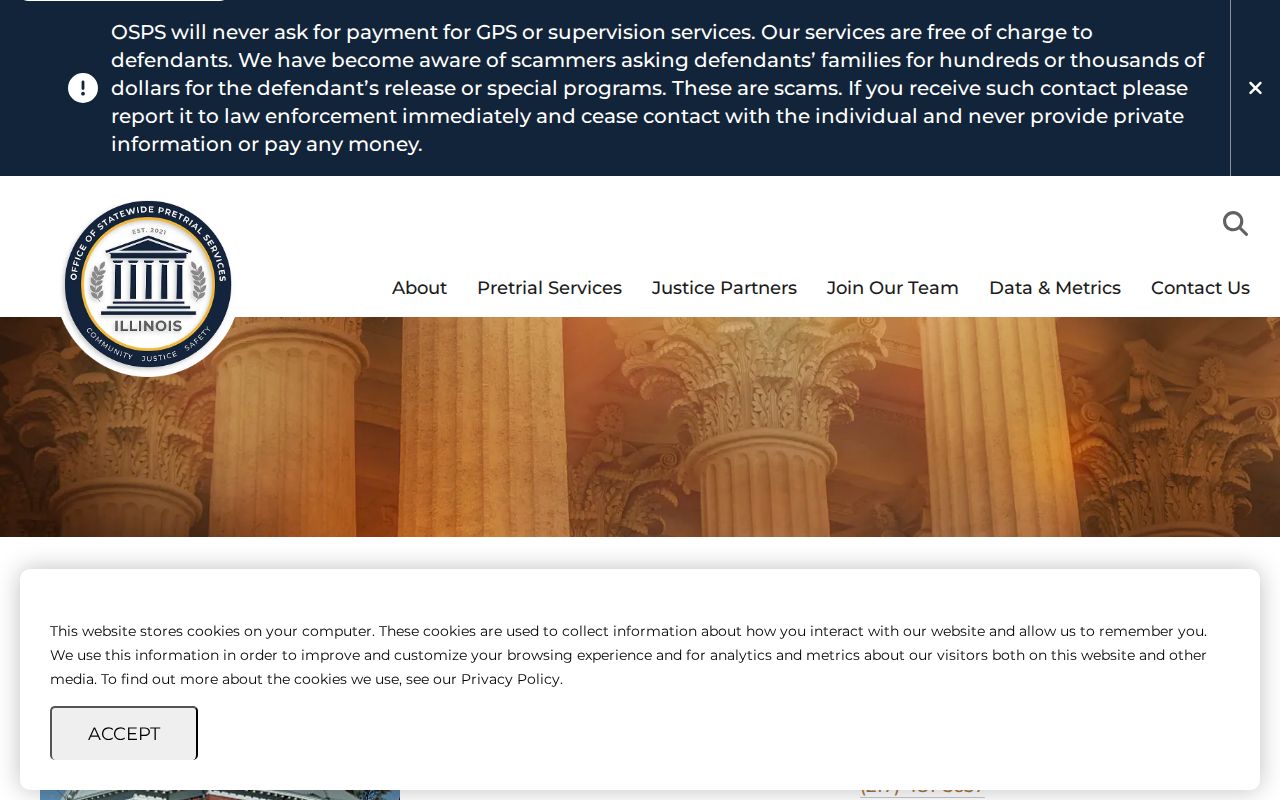
The OSPS contact helps verify pretrial supervision, but the court order and custodian's release entry remain the core release records.
Find Brown County Released Inmates
A name-only search is not enough. Begin with the arrest date and case number, then trace custody in order. This prevents a common error: assuming the state prison in Mt. Sterling booked every local arrestee. Brown County released inmates may have left a case-specific receiving jail, an IDOC prison, or another authority. Use the following path until one official record identifies the custody event.
- Call the Brown County Sheriff at 217-773-2011 and ask which agency accepted the person after the arrest. Record the facility, transfer date, and identifier.
- Search or contact that receiving jail. A live roster describes current custody; request its release transaction if the person has disappeared.
- Check Brown County cases on Judici for an order, disposition, sentence, probation, or IDOC commitment.
- Search IDOC when the case led to state prison, then read status, location, parole date, and projected discharge together.
- Use Illinois VINE for a participating custody status and alerts. Treat it as timely corroboration, not a permanent certified record.
- If federal or immigration custody appears, switch to BOP, ICE, or USMS records. Do not treat an interagency transfer as release.
- When online tools fail, submit a focused request to the office that held the part of the chain being verified.
The Released Last 24 Hours page explains the same-day fallback in detail. A missing person on a live roster is only a clue. Exact release time comes from the actual receiving jail's transaction, while legal authority comes from the court order or sentence.
IDOC Search for Brown County Releases
The working IDOC search form accepts a last name, IDOC number, or birthdate. It is the right system for Western Illinois Correctional Center, Clayton Work Camp, and any Brown County case that resulted in an IDOC commitment. It is not the locator for a short local arrest that never entered state custody. Confirm identity through the IDOC number, date of birth, aliases, sentence county, and offense entry rather than relying on a similar name.
| Search or profile field | How to read it |
|---|---|
| Last name, IDOC number, birthdate | Alternative search inputs; use an IDOC number when known. |
| Offender Status | Read with location. PAROLE can show release from prison to supervision. |
| Parent Institution and Location | Current administrative placement, not always the historic release site. |
| Projected Parole Date | An estimate based on IDOC's current sentence calculation, not an actual release. |
| Parole or Last Paroled Date | A recorded historical transition from prison to supervision. |
| Projected Discharge Date | The anticipated end of sentence or legal custody, often later than prison release. |
| Sentence Discharged? | Helps distinguish ongoing legal custody from final discharge. |
The official search form shown here helps identify the exact inputs and avoids commercial pages that falsely label a Brown County jail.
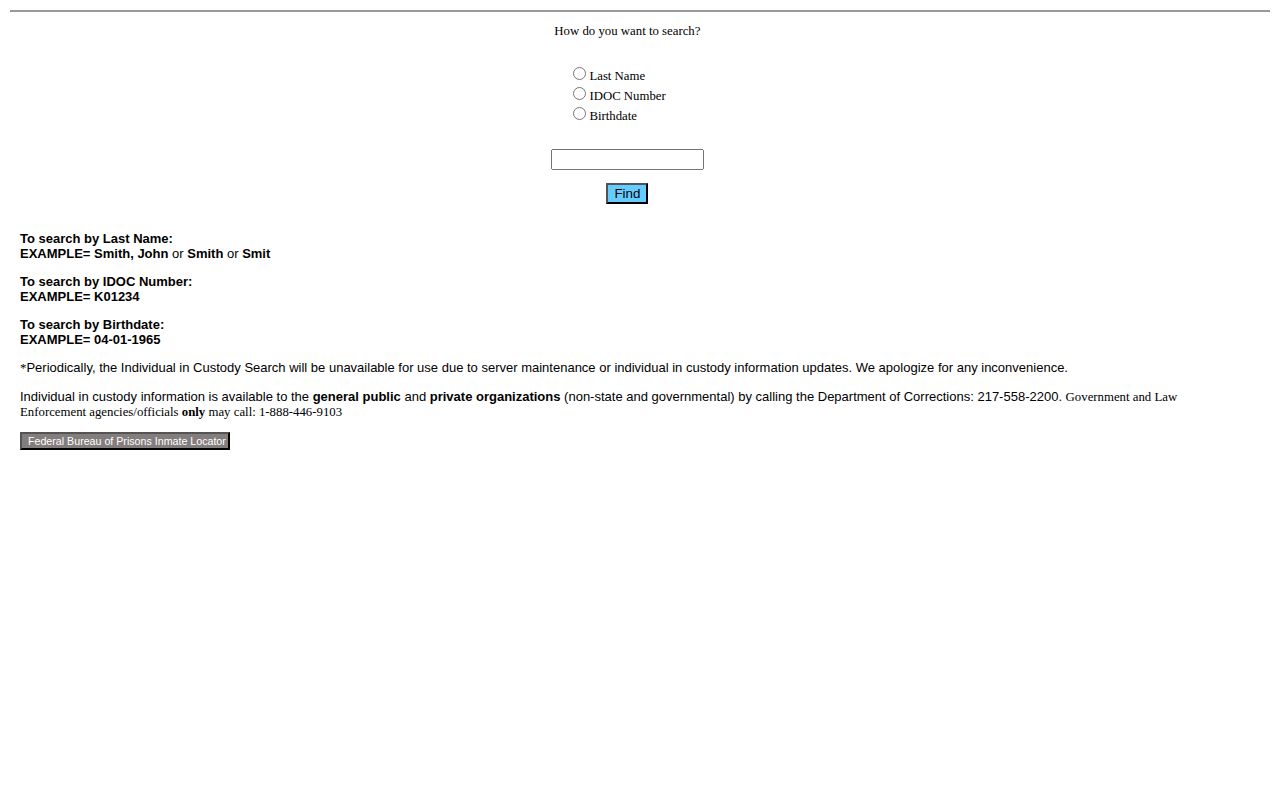
IDOC says completed-sentence profiles disappear from its public search. If a known former IDOC person is absent, try aliases and the IDOC number, then request archived public fields. Do not convert “no result” into a claim of discharge.
No Brown County Release Feed
Brown County publishes no jail roster, 24-hour release feed, or 72-hour release feed because it operates no jail. There is no local feed URL, window, field set, update schedule, retention period, or roster photograph to interpret. The official no-jail evidence is more reliable than commercial directories that invent a Brown County Jail. A reader seeking recent Brown County released inmates must first identify the actual receiving facility for the arrest.
The official Brown County profile is captured below. It establishes the missing local jail and changes the entire search method.
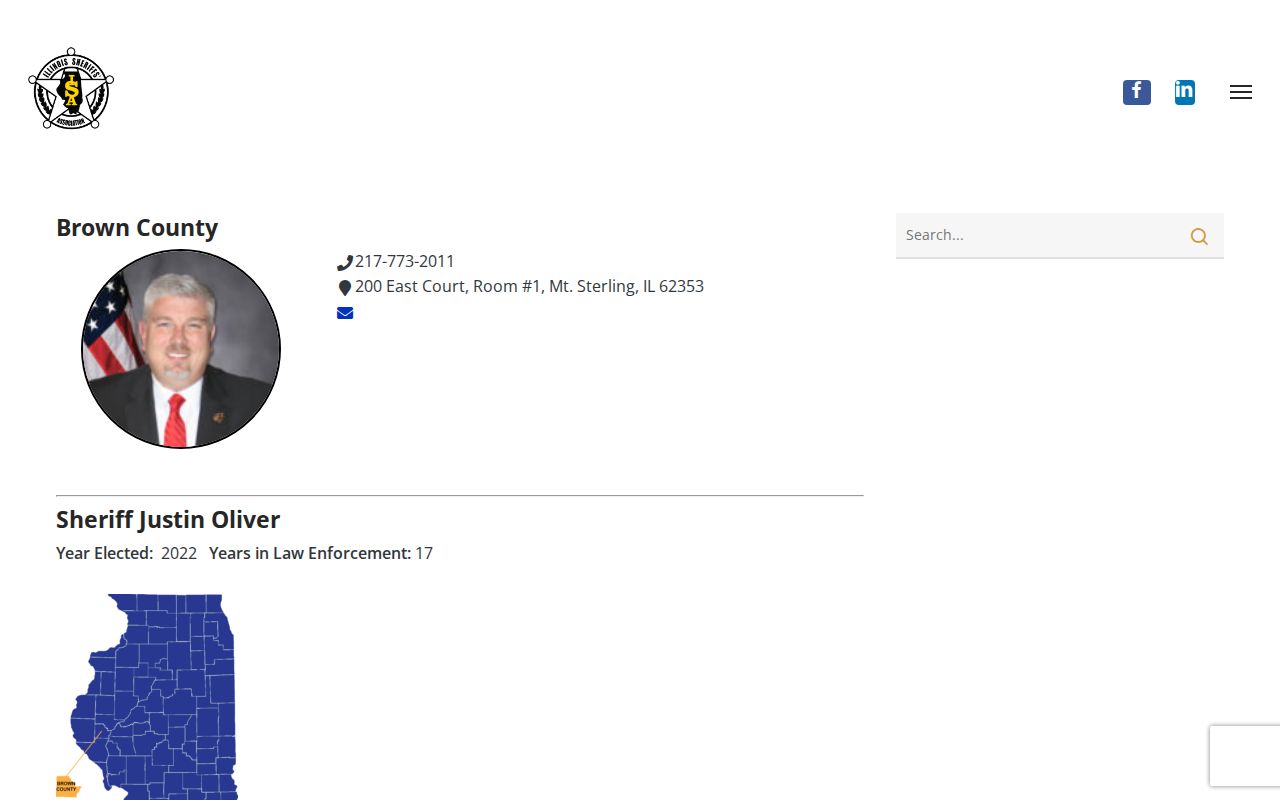
Once the Sheriff names the receiving jail, ask whether that jail has its own recent-release view. If it does not, request the release transaction directly and use VINE or the Brown County docket for corroboration.
Brown County Release Supervision
Probation, pretrial supervision, and IDOC parole or MSR are different. Probation is imposed by the court as a community sentence. Pretrial conditions apply before final disposition. Parole or MSR follows an IDOC prison term while IDOC legal custody continues. The Brown County docket can confirm probation or pretrial orders. For prison release, read the IDOC profile and contact IDOC Parole at 800-666-6744 when official confirmation is needed. The Illinois Prisoner Review Board handles specified hearings, revocations, and early or final discharge decisions.
Western Illinois Correctional Center lists Parole School, counseling, academic and vocational work, substance-abuse education, community work crews, and other institution programs. Those offerings create a real Brown County prison reentry context, but they do not prove that a named person participated or that any service continues after release. Brown County research found no county jail discharge program or county reentry office. Detailed verification steps appear on the Parole / Probation page.
Brown County Court Release Trail
Brown County's court trail matters more than it would in a county with a public jail archive. Judici can show charges, docket events, a release or detention order, disposition, probation, time-served sentence, or commitment to IDOC. The Brown County Circuit Clerk keeps the official record at 200 Court Street, Room 5, Mt. Sterling. Brooke R. Robinson's office can be reached at 217-773-2713 extension 2, Monday through Friday from 8:30 a.m. to 4:30 p.m.
The Circuit Clerk page supplies the official and certified-copy fallback. A docket may explain why custody should end but may not display the exact physical release timestamp. It also cannot rule out a hold in another case. For a certified outcome, request the filed disposition, release order, sentence, or mittimus by case number. For the exact custody event, pair that court record with the receiving jail's release or transfer entry.
Brown County Release Alerts
Illinois VINE provides participating custody and court-event information. Search by name or available identifier, verify the reporting agency, and read “released” as release from that named agency. Phone, text, email, or app registration may be available. Telephone registration uses a four-digit acknowledgment PIN, while the current Illinois brochure says email registration does not require one. Separate event categories can require separate registration. VINE is confidential, but it is not a certified archive and cannot create Brown County's missing release feed.
Federal custody needs a federal tool. The BOP inmate locator can display a federal release date or “Not in BOP custody,” which does not rule out USMS, state, local, or immigration custody. ICE's online locator covers current detention and certain recent releases for only a limited period. USMS has no general public inmate locator, so a federal district case and a focused records request may be necessary. Each result must name the system that released or transferred the person.
Brown County Custody Versus Release
A current-custody tool and a release record answer different questions. Start with the agency named in the arrest or sentence. Then use the system that owns that custody. Registries are limited to people with a statutory registration duty and are not general release tools.
| System | Still in custody | After release |
|---|---|---|
| Brown County Sheriff | Can route the arrest, but has no county jail roster | Arrest, transport, and locally held outcome records |
| Receiving jail | Its live roster, if published | Its release or transfer transaction and booking record |
| Brown County court | Detention orders and pending case events | Release order, disposition, probation, sentence, or commitment |
| IDOC | Incarcerated status and institution | Parole date/status, then archived fields after final discharge |
| VINE | Participating agency status | Timely release event or alert, not a permanent ledger |
| BOP or ICE | System-specific federal or immigration result | System-specific release data with stated limits |
Brown County Release Facility Map
Brown County's facility map has two arresting offices and two state correctional facilities. None is a Brown County jail. The Sheriff's Office and Mt. Sterling Police must identify the receiving jail for each local arrest. Western Illinois Correctional Center and Clayton Work Camp are IDOC facilities, so their release and discharge trail belongs to the statewide IDOC record.
- Brown County Sheriff's Office (No County Jail): local arrest and transport records; receiving jail varies.
- Mt. Sterling Police Department: municipal arrest records; ask which facility accepted custody.
- Western Illinois Correctional Center: medium-security IDOC prison; verify parole and discharge through IDOC and PRB.
- Clayton Work Camp: IDOC satellite under Western Illinois; movement to the parent prison is a transfer.
Western Illinois opened in April 1989. Its official page reported a dated capacity of 2,123 and population of 1,442 as of June 30, 2024. Those figures describe a state prison inside Brown County, not a place that receives all Brown County arrestees. Clayton is about 12 miles from the parent facility according to IDOC's FY2023 reporting. A facility's location inside the county does not establish custody in a local criminal case.
Travel After Brown County Release
West Central Mass Transit District serves Brown County. Mt. Sterling publishes 217-773-3025 as a local transportation contact, and West Central Mass Transit provides current service information. This is a trip-planning resource after a court appearance or verified community release. No reviewed source establishes an automatic Western Illinois prison pickup, a fixed gate stop, a family waiting area, or a standard release hour.
Confirm the custody outcome before arranging a ride. A person may be moved to another authority rather than exit to the community, and the physical release site may be outside Brown County when a local arrestee was held elsewhere. Call the actual custodian for time, gate, property, identification, and pickup rules. Call transit separately for service availability. Keeping those questions separate avoids turning a projected date into an assumed gate appointment.