
Brown County 24-Hour Release Gap
The Illinois Sheriffs’ Association Brown County profile states “No jail,” lists no jail administrator, and reports no county jail address or beds. That official fact controls the search. The Sheriff’s courthouse office must not be treated as a detention center. Brown County therefore has no Brown-operated live roster, release tab, booking-photo stream, or rolling same-day archive from which to compile a reliable list.
An arrest within Brown County does not identify the booking facility. A person may leave agency processing, move to an out-of-county jail, enter IDOC custody, or go to another authority. No official source names one neighboring jail that receives every detainee. The correct custodian must be established for the specific incident. Once named, that receiving facility’s release transaction is the best evidence of the time, type, and destination.
Check Brown County Same-Day Releases
Start with a full name, approximate event date, and any incident or case number. Ask the Brown County Sheriff one narrow routing question: which agency or facility accepted custody of this person after the event? A telephone answer helps route the search, but a written record is stronger when the exact outcome matters.
- Contact the Brown County Sheriff at 217-773-2011 or sheriff@browncoil.org and identify the incident.
- Record the receiving agency, facility, transfer date, and booking identifier supplied.
- Ask that receiving jail for its admission and release transaction, including the release or transfer code.
- Check the Brown County court docket for the order that may explain release, sentence, or commitment.
- Use Illinois VINE when the receiving agency participates, or IDOC search when state custody is identified.
For a broader date range, the Brown County releases from the last 72 hours explains weekend and posting-delay checks. A date alone is not enough. Preserve whether it is the event date, entry date, or the date a source was accessed.
Note: Ask the custodian whether its “release” code means community release or a transfer to another authority.
Brown County Release Record Fields
Because there is no county list, these are fields to request from the actual custodian, not claims about an online display. The Sheriff may hold arrest and transport details. The receiving jail normally owns the booking and physical release entry. A narrow request avoids asking Brown County for a jail record it never created.
| Field | What it can establish |
|---|---|
| Name and booking identifier | Links the transaction to the correct person and facility. |
| Admission date and time | Shows when the receiving jail accepted custody. |
| Release or transfer date and time | Documents when that custody ended or changed. |
| Reason or code | May identify court release, time served, sentence completion, or transfer. |
| Authorizing case or order | Connects the jail action to the Brown County court record. |
| Destination agency | Distinguishes community release from continued custody elsewhere. |
Ask for a plain-language definition of any code. An unexplained abbreviation can be misread. The court order may show legal authority but not the moment the jail opened the door, while the jail timestamp may show implementation without explaining the full case result.
Brown County Release Outcomes Compared
“Released” must always name the custody involved. A roster disappearance can reflect many events. Brown County’s missing local roster makes source labels even more important.
| Outcome | What it means | Best confirmation |
|---|---|---|
| Pretrial release | Detention ends under a court order while the case continues. | Court order plus receiving-jail timestamp |
| Time served | The ordered custody term is satisfied. | Sentence and release transaction |
| Probation | A community sentence imposed by the court. | Brown County court record |
| IDOC parole or MSR | Prison incarceration ends, but state supervision and legal custody continue. | IDOC profile and actual parole date |
| Transfer | Custody continues with another jail, IDOC, USMS, or ICE. | Destination field and receiving record |
| Final discharge | IDOC legal custody ends. | IDOC archived record or discharge action |
Dismissal or acquittal may explain why custody should end, but another hold can remain. Escape or death may also remove a person from a current roster and must never be labeled as a normal release.
Brown County Pretrial Release Help
Brown County has a named Office of Statewide Pretrial Services contact. The official Brown County courthouse page lists Pretrial Service Officer Brandi Goben at 217-481-5637 and bgoben@ilosps.gov. That office handles pretrial supervision, which is distinct from probation after sentence and IDOC parole after prison.
OSPS also warns that its GPS and supervision services are free. A demand for payment that claims money is required for release or monitoring should not be treated as an official condition without direct verification. The court order defines the conditions. The receiving jail’s timestamp confirms when physical detention ended.
Note: A pretrial release order allows release but may not record the exact time a receiving jail completed processing.
Transportation After Brown County Release
West Central Mass Transit District serves Brown County, and Mt. Sterling publishes 217-773-3025 as a local transportation contact. It can be used to ask about trip availability after court processing or a confirmed release. The local source does not establish an automatic pickup from Western Illinois Correctional Center, a fixed prison-gate stop, or a family waiting area.
Confirm the place and time first. Brown County cannot publish one release gate because it has no county jail and the actual receiving facility varies by arrest. For a state-prison release, ask IDOC or the institution about current logistics. For an out-of-county jail, ask that jail where lawful pickup occurs. A transit contact is a planning resource, not proof that a release happened.
Brown County Sheriff App Limits
The official Brown County Sheriff IL OCV app launched in August 2025. Its verified features include alerts, crime updates, press releases, tips, road information, and community resources. Neither the county announcement nor the store description verifies an inmate lookup, recent-release list, or mugshot feed.
The official app listing shows the public-safety functions documented by the county.
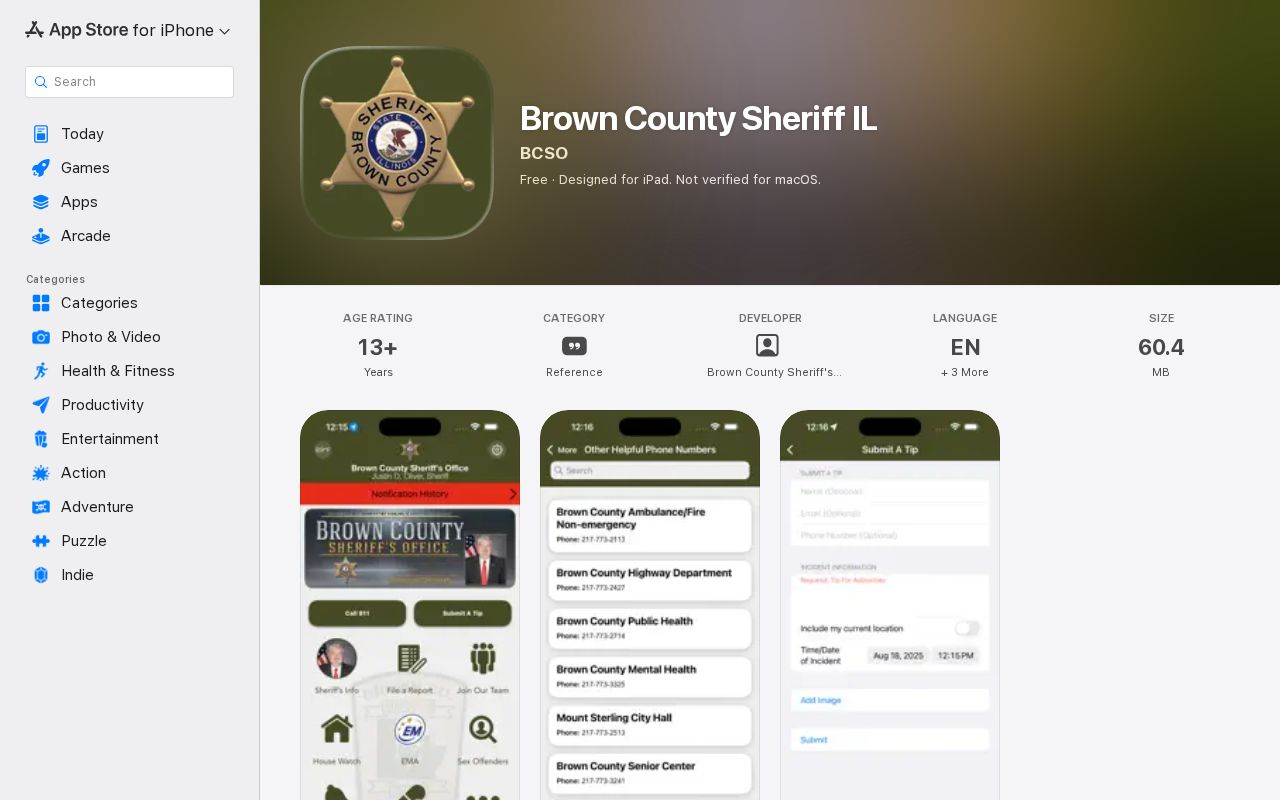
Use an app alert as an incident lead, then obtain the custody outcome from the Sheriff, receiving jail, or court. An app item does not become a physical release transaction merely because it names an arrest.
Brown County Release News Leads
Dated Sheriff’s Reports and event-driven regional coverage are useful for finding an incident date, arresting agency, or case context. They are selective publications, not complete daily custody logs. Some reports include a photograph or point readers to the Sheriff’s app, but neither channel proves the person was released.
Follow a news lead back to the record owner. The Sheriff can identify transport. The receiving jail can document its release or transfer. Judici and the Circuit Clerk can show the court action. This source chain prevents an old report, later update, or photo from being mistaken for a same-day Brown County release.
Confirm Brown County Release Status
If the destination was IDOC, use the state offender search. A status of PAROLE together with a parole district and actual Parole or Last Paroled Date is stronger evidence that prison incarceration ended. A projected date is not an actual release. IDOC also removes completed-sentence profiles from its public population, so no result may require an archived-record request.
Illinois VINE can send notice of release, transfer, escape, and other events from participating sources. It is timely corroboration, not a certified Brown County archive. A “released” event applies only to the reporting custody. A transfer alert means custody continued. For the most durable explanation, compare the custodian’s transaction with the Brown County court order.
Note: VINE, IDOC, court, and jail records describe different systems, so matching identity and source agency is essential.
Public Record Search
Sponsored Results
Brown County Same-Day Source Order
Use the strongest source for each part of a same-day outcome. The receiving jail’s release transaction is best for the physical date and time. A filed Brown County court order is best for the legal authority, such as pretrial release, dismissal, time served, or sentence. The Sheriff’s transport record identifies where local custody went. IDOC is the authority for state-prison status, parole dates, and final discharge fields. VINE is useful for a prompt alert, but its notice should be checked against the agency that supplied it.
Conflicts do not always mean one source is wrong. An order can precede processing, and a notification can follow the event. Keep each timestamp with its label and source. If a report says only “no longer held,” ask whether the person entered the community, went to court, moved to another jail, entered IDOC, or transferred to a federal or immigration authority. That follow-up prevents a custody handoff from being reported as a Brown County same-day community release.