
Clayton Work Camp Release Meanings
Leaving Clayton Work Camp does not always mean freedom from custody. A person may be released from prison to parole or mandatory supervised release, called MSR. The person then lives outside the institution but remains in IDOC legal custody until discharge. Another person may reach sentence completion and final discharge. A move to Clayton Work Camp, another IDOC prison, federal authority, or another custodian is a transfer.
The record must name the event. “Paroled” describes release from prison to supervision. “Discharged” means the IDOC sentence authority has ended. “Transferred” means confinement or legal custody continues elsewhere. A projected parole or discharge date is only an estimate and cannot prove that an event occurred.
| Outcome | Custody meaning | Best record |
|---|---|---|
| Parole or MSR | Out of prison, still under IDOC legal custody | IDOC profile and parole date |
| Final discharge | IDOC sentence authority ends | IDOC archive and applicable PRB record |
| IDOC transfer | Still incarcerated at another placement | Status, parent institution, and location |
| Projected date | Expected event that can change | Current IDOC profile |
Search Clayton Release Records
Open the IDOC Individual in Custody Search or its working search form. Search by last name, IDOC number, or birthdate in the format shown. Compare the result's name, date of birth, and IDOC number before opening the full profile. Similar names can otherwise produce a false match.
- Choose last name, IDOC number, or birthdate as the search route.
- Match identity fields before selecting a result.
- Read Offender Status with Parent Institution and Location.
- Separate projected dates from Parole Date or Last Paroled Date.
- Check whether each sentence line says it is discharged.
The strongest public evidence of release from prison to supervision is a PAROLE status, a parole-district location, and an actual Parole Date or Last Paroled Date. A future Projected Parole Date does not show release. An incarcerated status at a new location points to transfer, not community release.
Clayton Work Camp Search Fields
IDOC profiles combine current placement, sentence, identity, and projected date data. Read related fields together. Parent Institution is an administrative assignment and Location is the reported placement. Neither alone proves the institution from which a past release occurred.
| Field | What it tells you |
|---|---|
| Offender Status | Whether the person is incarcerated, on parole, or in another displayed state |
| Location | Current reported institution or parole district |
| Admission Date | Entry date shown for IDOC custody |
| Projected Parole Date | Expected parole-related date, not an actual exit |
| Parole or Last Paroled Date | Displayed actual parole event |
| Projected Discharge Date | Expected end of sentence authority |
| Sentence Discharged? | Sentence-level indication that must be read with the full profile |
Sentence entries can also show mittimus, offense, class, count, custody date, term, and county. A mittimus is the court commitment document. These facts help distinguish a Brown County sentence from a person who merely resides at a prison located in the county.
Clayton Release Archive Fallback
IDOC says its public search displays people who are incarcerated or on parole. A person whose sentence is complete may disappear from the public results. Absence is therefore not proof of no prison history or no discharge. Search alternate spelling and the IDOC number first, then use an archived-record request.
The IDOC FOIA office can receive a focused request for releasable admission, actual parole or release date, final discharge date, status, IDOC number, and sentencing information. Include the full name, birthdate, IDOC number if known, and the date fields needed. Ask separately about institution history if it is important to prove Western Illinois placement.
IDOC FOIA1301 Concordia Court
P.O. Box 19277
Springfield, IL 62794-9277
DOC.FOIARequest@illinois.gov
217-558-2200 ext. 4166
Fax: 217-558-5612
PRB decisions may support a parole, revocation, or early or final discharge action when that board had a role. The sentencing court can provide the mittimus and disposition. Those records corroborate the IDOC dates but do not replace the agency's own custody transaction.
Clayton's Satellite Facility Role
The official Western Illinois facility page identifies Clayton as a minimum-security satellite under Western Illinois. IDOC annual reporting places it about 12 miles from the parent prison. The parent page reported 35 people at the camp in its dated data. That is a snapshot, not a claim about the current count.
The official manifest image captures the same prison and work-camp facts. View the IDOC source for the captured facility page.
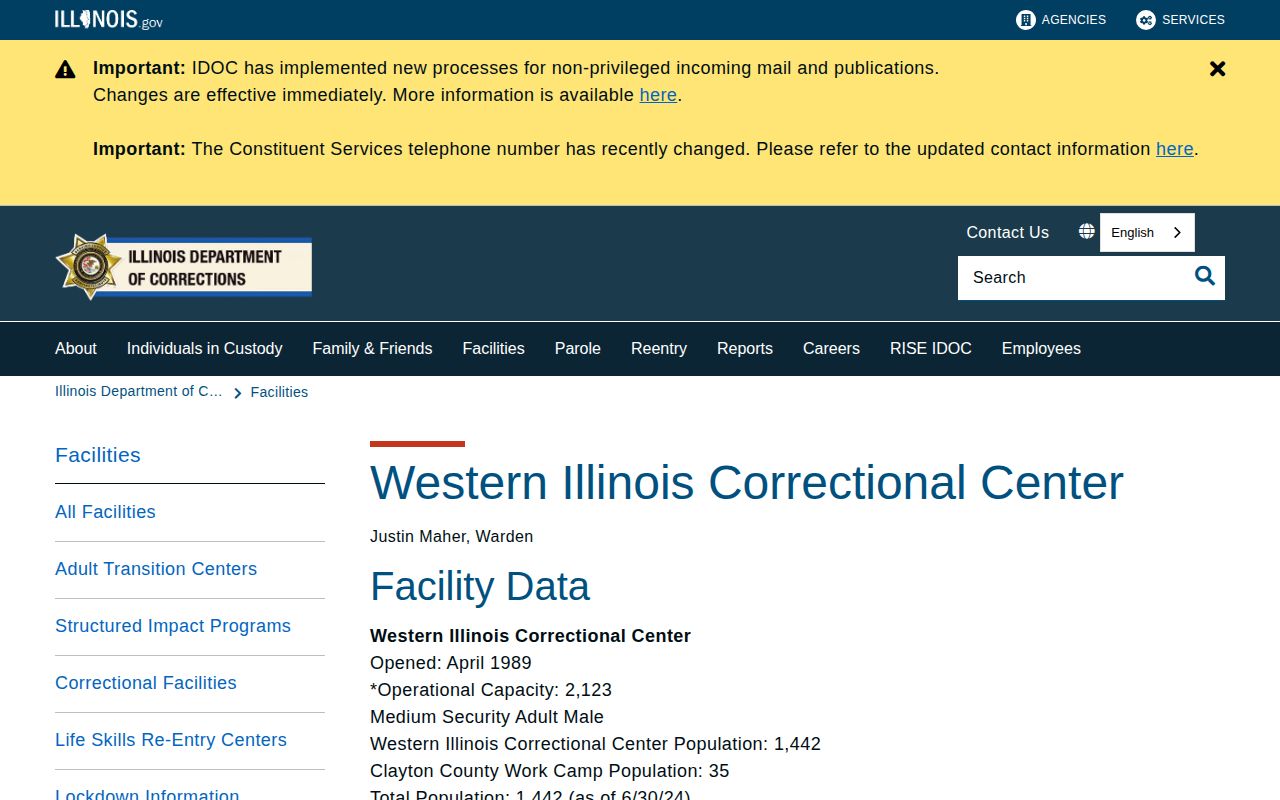
The image supports the institution type and parent relationship. It does not establish a release time, exit gate, or present population.
Clayton's Brown County Distinction
Brown County has no county jail, while Western Illinois Correctional Center sits within the county. This is Angle L's distinctive custody map. The state prison is not a substitute county jail and does not receive every person arrested by the Sheriff or Mt. Sterling Police. A court commitment and IDOC admission establish state custody.
Likewise, a person can be incarcerated at Western Illinois because of a sentence from another Illinois county. Facility location does not make it a Brown County criminal case. Check the county field in each sentence entry and the court mittimus. For local arrests, identify the actual receiving jail case by case through the arresting agency.
Clayton Work Camp is a satellite of Western Illinois, but movement between them remains an IDOC transfer. It is not community release. This distinction should appear in every account of a person leaving either institution.
Clayton Work Camp Duties
IDOC reporting says camp participants assist the main facility with grounds, recycling, commissary, and janitorial work. This describes Clayton's operational link to Western Illinois. It does not prove one person's assignment, sentence credit, release eligibility, or later placement.
IDOC's release procedures govern preparation and documents, while sentence credit depends on the offense, dates, conduct, and applicable law. Do not estimate a date by applying one fixed percentage. The current calculated IDOC profile is stronger than a hand calculation. A projected date can change because of credit decisions, discipline, court action, holds, or other lawful factors.
No official source reviewed publishes the daily release hour, public exit gate, family waiting area, property-pickup process, or weekend rule for Western Illinois. Call the institution before planning travel. West Central Mass Transit serves Brown County, but no source establishes an automatic prison-gate pickup.
Clayton Contact and Confirmation
Use the Western Illinois parent contact for current camp logistics that are not posted. Use IDOC records staff for official date confirmation. A phone answer can help route the inquiry, but a written record is the stronger source for release, parole, or discharge.
Clayton Work CampIDOC satellite under Western Illinois Correctional Center
Parent contact: 2500 Route 99 South, Mount Sterling, IL 62353
Phone: 217-773-4441
Fax: 217-773-2202
For a person still shown as incarcerated, the profile is a current-custody source. For a person on parole, it can document release from prison to supervision. For a completed sentence that has vanished from search, request the archive. The Brown County release search overview explains how that state trail differs from local arrest and receiving-jail records.
Note: Always label the date as projected parole, actual parole, projected discharge, or final discharge instead of using the terms interchangeably.
Confirm Clayton Placement and Exit
An IDOC profile may identify a parent institution and a current location, but those fields do not always supply a full placement history. Clayton is administered under Western Illinois, so a profile can reflect the parent relationship while the person is assigned at the camp. To prove a specific Clayton stay or exit, request releasable institution history in addition to the ordinary admission, parole, and discharge fields.
Internal reassignment has its own record meaning. Moving from Clayton to Western Illinois, reception, or another IDOC prison keeps the person incarcerated. It is not release merely because the camp assignment ended. Release to parole or mandatory supervised release ends confinement but continues IDOC legal custody. Final discharge ends that sentence authority. Each conclusion needs the matching status and date.
The work-camp description also has limits. Grounds, recycling, commissary, and janitorial duties describe the camp's institutional role. They do not establish that one person had a certain assignment, received sentence credit, or qualified for release. Credit depends on the governing sentence rules and IDOC's calculation. Do not estimate an exit date from minimum-security placement or program participation.
If the person is absent from public search, try the IDOC number and alternate spelling before requesting archived records. Ask for admission, actual parole or release, final discharge, status, and releasable placement history. Court records can verify the sentence county and mittimus. Applicable PRB material can document board action. Together, those sources separate a Clayton transfer from community release and final discharge.